
Lab-Grown Diamonds

What Are Lab-Grown Diamonds?
Lab-grown diamonds are precisely crafted diamonds created within laboratory settings rather than being formed naturally beneath the Earth's surface. These lab-grown diamonds showcase the incredible potential of modern technology, offering a sustainable and ethical alternative to traditional gemstones.

How Are Lab-Grown Diamonds Created?
Lab-grown diamonds are mainly created using a method called chemical vapor deposition (CVD).
Here's how it works:
- A tiny diamond seed is placed in a chamber filled with gases like methane.
- The chamber is heated to very high temperatures.
- The gases break down, releasing carbon atoms.
- Carbon atoms stick to the diamond seed, layer by layer, forming a larger diamond.

This process allows scientists to control the diamond's quality and characteristics precisely. Compared to other methods, CVD is cost-effective and scalable, making it the preferred choice for creating lab-grown diamonds.
Comparing Earth-Mined and Lab-Grown Diamonds

The primary difference between earth-mined and lab-grown diamonds lies in their origin and production process.
Earth-mined diamonds are naturally formed deep within the Earth's crust over millions of years, through intense heat and pressure acting on carbon atoms. These diamonds are then extracted through mining operations, which have significant environmental and social impacts, including habitat destruction, pollution, and labor exploitation. Many mined diamonds are associated with instances of child labor, hazardous working conditions, and human rights abuses in regions where diamond mining is prevalent.

Conversely, lab-grown diamonds are created in controlled laboratory settings using advanced technological processes. By mimicking the natural diamond formation process, scientists can produce diamonds with identical optical, physical, and chemical properties to mined diamonds without contributing to these harmful practices.
This ethical advantage makes lab-grown diamonds an increasingly popular choice for consumers seeking both quality and conscientiousness in their diamond purchases, aligning with our mission to promote sustainably and ethically manufactured jewellery.
Every jewelry brand solves the same three problems.
We solved them fourty years ago.
Sourcing. Certification. Manufacturing. Whether you already run a jewelry business or you're just starting to picture one — we build what happens behind the counter, so you can build what happens in front of it.
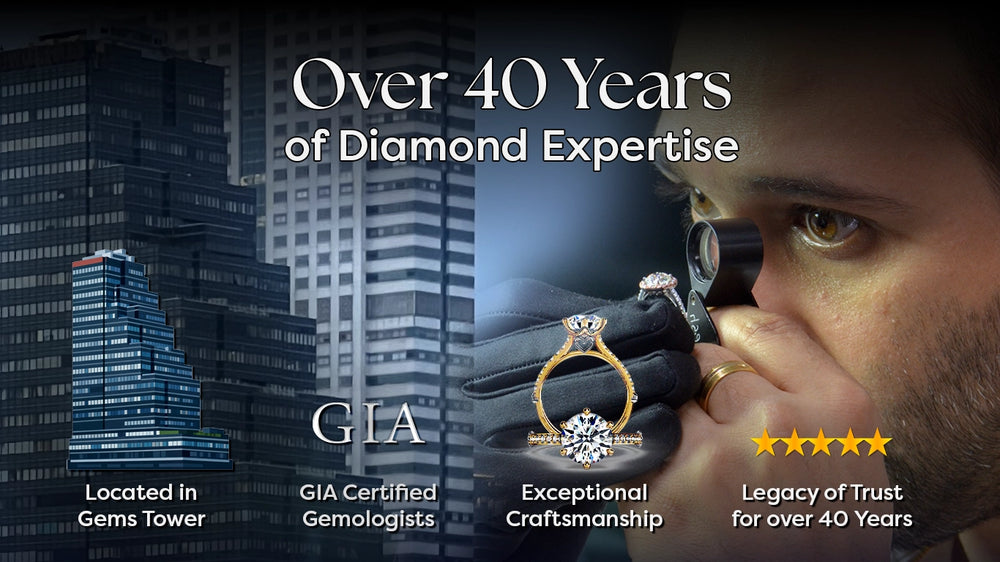
Nobody warns you what actually stands between an idea and a finished piece of jewelry.
Finding stones you can trust
Certified and/or hand-selected diamonds and colored stones, at a price that leaves room for margin.
CAD and production planning
Our in-house CAD team, made up of trained gemologists, designs every piece with manufacturing in mind, consequently preventing production issues.
Turning a concept design into a piece
Getting a design made without hectic back-and-forth with a factory.
Giving customers a reason to believe you
Certification and consistency your customers can check for themselves.
We didn't read about these problems — over the years we solved them on our own with an inexplicable amount of trial and error. As the saying goes, "experience is the best teacher". Now that experience of sourcing, grading, and manufacturing is open to you.

Ways to work with us, depending on where you're starting from.
Wholesale Natural or Lab-Grown Diamonds and Colored Stones
Loose stones and finished settings, GIA-trained grading on every parcel.
Custom & Private-Label Production
In-house CAD design team and production factory. Silver, 9K, 14K, 18K Gold, and Platinum. We can take care of your Packaging too, on volume.
Small-Batch & One-Off Orders
Testing an idea before you commit to volume? We're built for that too.
Certification You Can Pass On
GIA, HRD, or IGI-certified for applicable sizes, verifiable by your customers.
Not a reseller. A family manufacturing business you can visit.
Serenity Diamonds™ is run by third-generation jewellers with over fourty years in the trade. We're a working manufacturing floor in Bangkok's gem district.
Every partnership runs through the same GIA-trained grading and GIA/IGI certification process.
Different stage, different problems. We've been on both sides of these.
Finding a trustworthy manufacturer
The ProblemFactories generally overpromise quality, craftsmanship is inconsistent between orders, communication breaks down (especially overseas), and hidden costs appear after production starts — leading to delayed orders and damaged reputation.
How We've Solved It
Three generations in the industry, one family business, and you can actually visit us. We're not just another listing on a directory. We are GIA-trained gemologists and handpick + QC everything that leaves our hands, so there are no surprises after the invoice.
High minimum order quantities
The ProblemMost factories require 20–100 pieces per design and a large deposit, and we understand that a new brand usually just wants one prototype or five pieces to test the market.
How We've Solved It
We build for single-sample and small-batch orders from day one. You don't need volume to get a real answer.
CAD and design issues
The ProblemA beautiful CAD render that can't actually be produced, so you may face weak structural integrity, stone seats that don't fit, excess metal weight, and all this leads to multiple costly revisions.
How We've Solved It
Our in-house CAD designers are also trained gemologists, so every design is created with real-world manufacturing in mind. Before committing to production, you'll be able to see and hold a physical sample to ensure it meets your expectations.
Understanding manufacturing costs
The ProblemWhy is platinum so much more expensive? Why is pavé labor higher? Without understanding the real cost drivers, it's hard to quote customers accurately.
How We've Solved It
We walk you through the actual cost breakdown of your build — metal, labor, stone selection, and setting cost — so you can quote your customers with confidence rather than guesstimating.
Cash flow
The ProblemMost factories require a big deposit and full payment before shipping, while customers often want to pay after delivery or in installments — leaving the jeweler to fund the gap.
How We've Solved It
We talk through the payment structure with you at the sample stage, before you're committed to a full production run, so the gap doesn't catch you mid-order.
Consistency across runs
The ProblemOne piece looks perfect. The next ten don't. Maintaining identical quality across larger production runs is surprisingly difficult.
How We've Solved It
Every piece, sample or production run, goes through the same GIA-trained grading and a stringent QC process. Volume doesn't mean a lighter standard.
Coordinating multiple suppliers
The ProblemUsing separate vendors for casting, stone setting, plating, and engraving makes it hard to hold every step to the same standard.
How We've Solved It
Fewer handoffs between outside vendors means fewer places for standards to slip. We are one-stop solution for the entire production line.
Production bottlenecks
The ProblemOne slow department between CAD, casting, setting and polishing, plating, and final QC delays everything downstream of it.
How We've Solved It
An in-house CAD and manufacturing team means we're not waiting on a third-party queue to clear before your order can move.
Returns and remakes
The ProblemEvery remake costs metal, diamonds, labor, shipping, and reputation. Even a 2–3% remake rate can meaningfully cut into margin.
How We've Solved It
Every piece is inspected against the same stringent QC standard before it ships. If by some reason you need to return, we accept returns up to 15 days after your delivery has been received.
Scaling custom work
The ProblemCustom jewelry is profitable but hard to scale — every order consumes real consultation, CAD, approval, and revision time.
How We've Solved It
A dedicated in-house CAD team gives you custom capacity that grows with your order book, instead of one overworked designer becoming the bottleneck.
No factory tour required before step three.
Consult
Tell us what you're trying to build, and if you're still figuring it out, we will help you.
Design & Source
Our CAD team drafts the piece, and we'll source stones to your requirements.
Sample
You see and hold the piece before committing to any volume.
Produce & Ship
Manufactured in Bangkok, shipped worldwide.
The questions that usually come up first.
That's fine. Start wherever you're comfortable.
Message us on WhatsApp
Chat directly with the team — no form, no waiting for a callback.
Open WhatsApp →Call the team directly
For when you're ready to discuss a real project, sourcing, or manufacturing run.
Call +66863634500 →Tell us a little about what you're building — we'll take it from there.
However you reach out, a real person on our team reads it — not a queue.
